A group of enthusiasts established the Margaret Rope Archive in 2020, having assembled (from a number of sources) around 500 drawings and ‘cartoons’ by Margaret, as well as other relevant documents and works by her.
Research carried out at the Archive since has thrown a great deal of light on how Marga, and, by inference, other stained glass artists of the time, worked on their productions. As you’ll now read, sometimes artists’ plans had to be radically altered, especially when circumstances changed.
+
The Archive is not just a collection. Once brought together, the artefacts can also tell us stories and provoke discussion. All it needs is the desire to think like a detective.
Take for example these two cartoons, which Marga made in the early 1930s and which are still in the possession of the Archive:
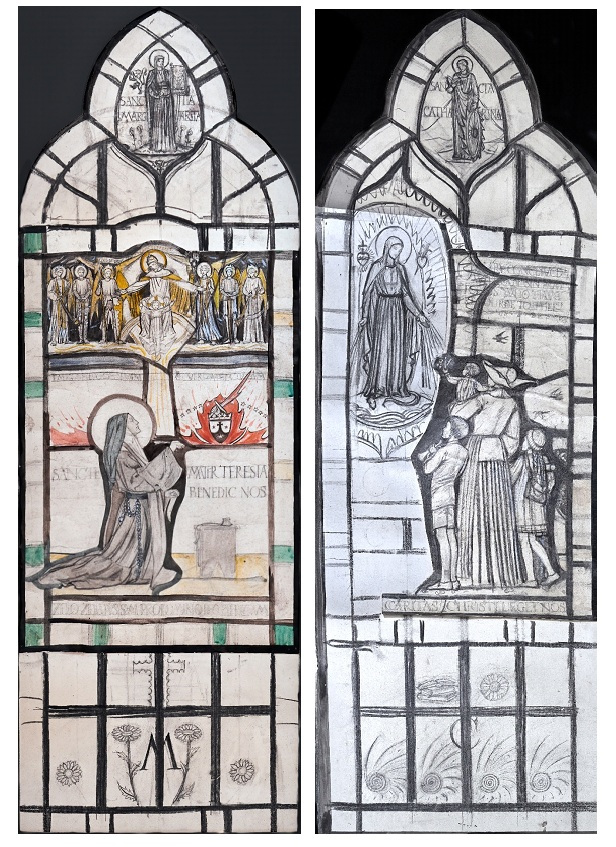
Usually, cartoons are the last stage in the design process; they will be presented to the sponsor as a finished idea of what the eventual window will look like. But these two cartoons are quite cut-about, and have even been pasted over in places. In other words, they are a re-working of original cartoons – and that tells a tragic story.
The original (smaller) cartoons were created to be made as small panels: presents from Margaret to her dear youngest brother, Michael, (known to the world as Squadron Leader Rope, the airship designer) who had just married his young bride Lucy Doreen Jolly.
Re-design
The Saint Teresa design (the one on the left) was originally meant for a small frame; probably using just the central rectangular section dedicated to Saint Teresa.
You can tell however that the original cartoon was subsequently cut about and then pasted onto a larger sheet of paper, allowing for a completely new features around it; including a light of St Margaret of Scotland at the top. This re-worked, larger design was to become the St Teresa Window at Kesgrave RC Church.
Something similar has happened to the cartoon for a proposed Our Lady & Children work. One can see from the cuts that the original section was even more radically changed than for the Saint Teresa window: keeping only the family grouping on the right from the original. Again, the old cartoon now has all new features around it, and the extra space means a larger figure of Our Lady, as well as a dedication to St Catherine in a top light. This became the Our Lady & Vaughan Children Window, also now in Kesgrave Church.
By studying the cutting-and-pasting of these cartoons in the Archive, one sees the later, resulting windows in a new light. It also becomes possible to see Margaret’s thinking in how she developed them.
Tragedy
But why were the designs redrafted and revised at all? Therein lies the tragedy.
In early October 1930, Michael Rope set off from England in the R101 airship on a prestige trip to India via Egypt, leaving his new wife Lucy behind; she was by now heavily pregnant.
In fact, he already knew that the voyage would be perilous and he told a friend that he did not expect to return from it alive. He was tragically correct. The airship encountered extreme weather conditions in Northern France and crashed a little south of Beauvais. Nearly everyone on board was killed in the resulting conflagration.
And so these two putative wedding presents had to be repurposed.
New church
Back home, his grieving family resolved to build a chapel in his memory at Kesgrave village near the family home and it was decided that Margaret would produce some windows for the church.
As we have seen, what she did was radically re-think the designs she already had and incorporate them into a new, larger designs. They had to be larger, as they were now to be full windows, meant to fit window spaces in the porch of the new memorial church (see pictures below).

The first stage of the Holy Family & St Michael Church was built remarkably quickly, to open in 1931 (with extensions in 1955 and 1992); Margaret Rope was eventually to contribute eight complete windows and panels to it, including ones of a more personal nature, remembering Michael.
As these things can do, the fast re-vamp of the designs actually ended well – despite the sad circumstances.
Mostly because of her eight windows, some of the most astonishing she ever created, Simon Knott, in his illustrated monograph on Kesgrave Holy Family Church, and its windows and its monuments, describes this small church as “one of the great 20th Century artistic treasure houses”.
Adapted from a study-paper by AR; additions by MS
See also: Discoveries from the Archive 2; The Process and Discoveries from the Archive 1; Lost Windows. For more on the work of the Margaret Rope Archive, please click here
~
# If you’d like to comment on this article, please use the Comments Box below
# If you’d like an email alert to tell you when a new article is published on this website (about once a month), please click the ‘Follow’ button in the top right-hand column on this page.
 Celebrating Margaret Rope - stained glass-artist