It is a source of great frustration that we know so few of the details of Margaret Rope’s life. But the flipside of that is that extraordinary finds are being made all the time, some of them quite new, and some of them just, well, new to us.
For instance, some windows in Yorkshire, once attributed to Burne-Jones, are now thought to be by Marga; and it turns out that, in designing them, she may well have become friends with the man on whom the great fictional detective, Father Brown, was modelled!
Father O’ Connor … Father Brown
Many people will have heard of the Father Brown stories in which an apparently simple, ordinary parish priest solves crimes using his understanding of the human soul. The stories, written by GK Chesterton in the early years of the twentieth century, are delightful and clever.
The latest dramatisation of the stories is showing on BBC TV at the moment.
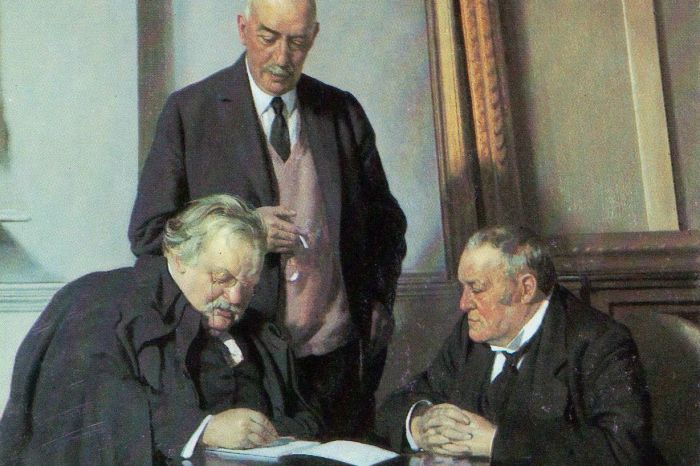
Chesterton admitted that he’d got the idea for the character from observing his friend, Father John O’Connor, a parish priest at Heckmondwike in Yorkshire. Despite being ‘just’ a local priest, Father O’Connor was hugely energetic and had a cultured turn of mind, and yet also seemed to have a spiritual understanding of ‘the darkest recesses of men’s minds’.
A recent book, The Elusive Father Brown (Gracewing, 2010), by Julia Smith, explores the pair’s relationship … which is where Marga comes in.
Re-discovery
Julia points out in her book that Father O’Connor made many friends in the intelligentsia – including Bernard Shaw, the sculptor Eric Gill, and crucially for us, the poet, historian and fellow priest Henry Rope. Henry was Marga’s brother.
Julia believes that when Henry came to visit in Yorkshire in 1912, he may have suggested his sister should design and make some windows for the new church that Father O’Connor was building.
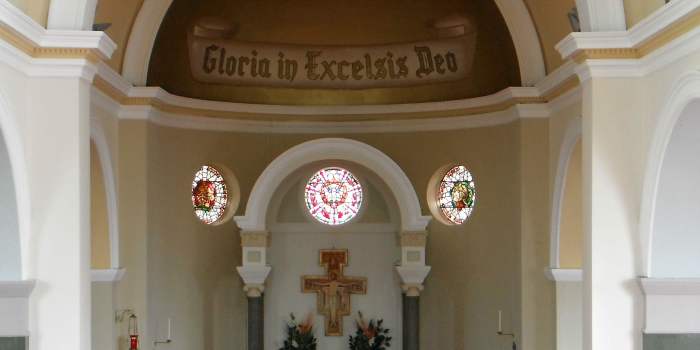
Sure enough, when the Holy Spirit Catholic Church in Heckmondwike was opened in 1915, the local paper of the time reported that Margaret Rope was the artist who had contributed to the small windows above the High Altar.
Julia’s research for her book also found a memoir of Fr O’Connor written by Henry Rope for the Venerabile Journal – in it, Henry repeats that “his sister” (Marga) was the artist for the stained-glass in the church.
Arthur Rope, who maintains the official Margaret Rope website, credits Julia with re-discovering this important addition to the Marga catalogue.
(However, there is some confusion, even to this day, as to whether all three lunettes at the east end of the church are hers or just the central one. Because none of them really resembles the rest of her work, some more research may need doing on this).
Window/s
The three circular stained glass windows above the High Altar depict a Dove, the symbol of the Holy Spirit (the central one), St. John (on the left) and St. George (on the right).
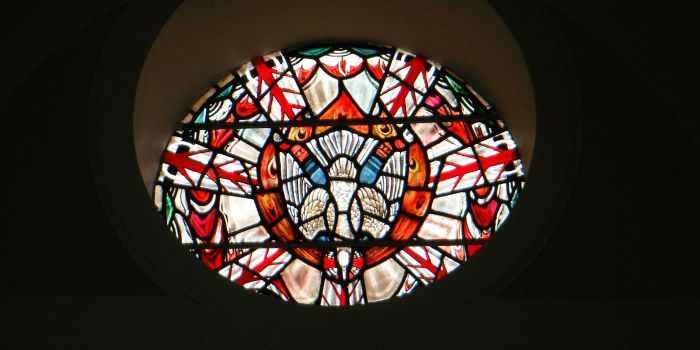
Strangely, the St. John and the St. George were attributed, back in the day, to Burne-Jones, even though they are nothing like Burne-Jones’ work, and he’d been dead since 1898…
What Marga made of Father O’Connor, and what he made of her, would be fascinating to speculate.
Someone with a doctoral thesis to write may one day take up the research (we hope) and find out the full story!
References:
Who was GK Chesterton’s Father Brown? – from Catholic World
Holy Spirit Parish, Heckmondwike – A Centenary of Change by Peter Moreland is a beautifully researched and thorough history. Only available through the church or by contacting the author
Holy Spirit Parish, Heckmondwike – the website
If you’d like to leave a comment, please use the comments-box further down this page.
 Celebrating Margaret Rope - stained glass-artist