One of the main attractions for visitors to Shropshire is the medieval St Mary’s Church in the centre of Shrewsbury. This huge, wonderfully decorated building, now in the hands of the Churches Conservation Trust, is currently open six days a week.
Its stained glass is its real glory; and, in 2022, there was a big project to conserve and tidy it. At this time also, loose panels and fragments were brought out of storage and repaired, to be put on show. These loose pieces, some of which are wonderful, are now on permanent exhibition in the church.
Most of the glass found in storage was easily identifiable, but, strangely, the provenance of one of the largest and most lovely windows was not. Its story had been lost.
Thus this triptych, with the Madonna & Child in the centre of it (see pic below), and the saints Catherine and Francis to either side of her, became known as the ‘mystery glass of St Mary’s’.
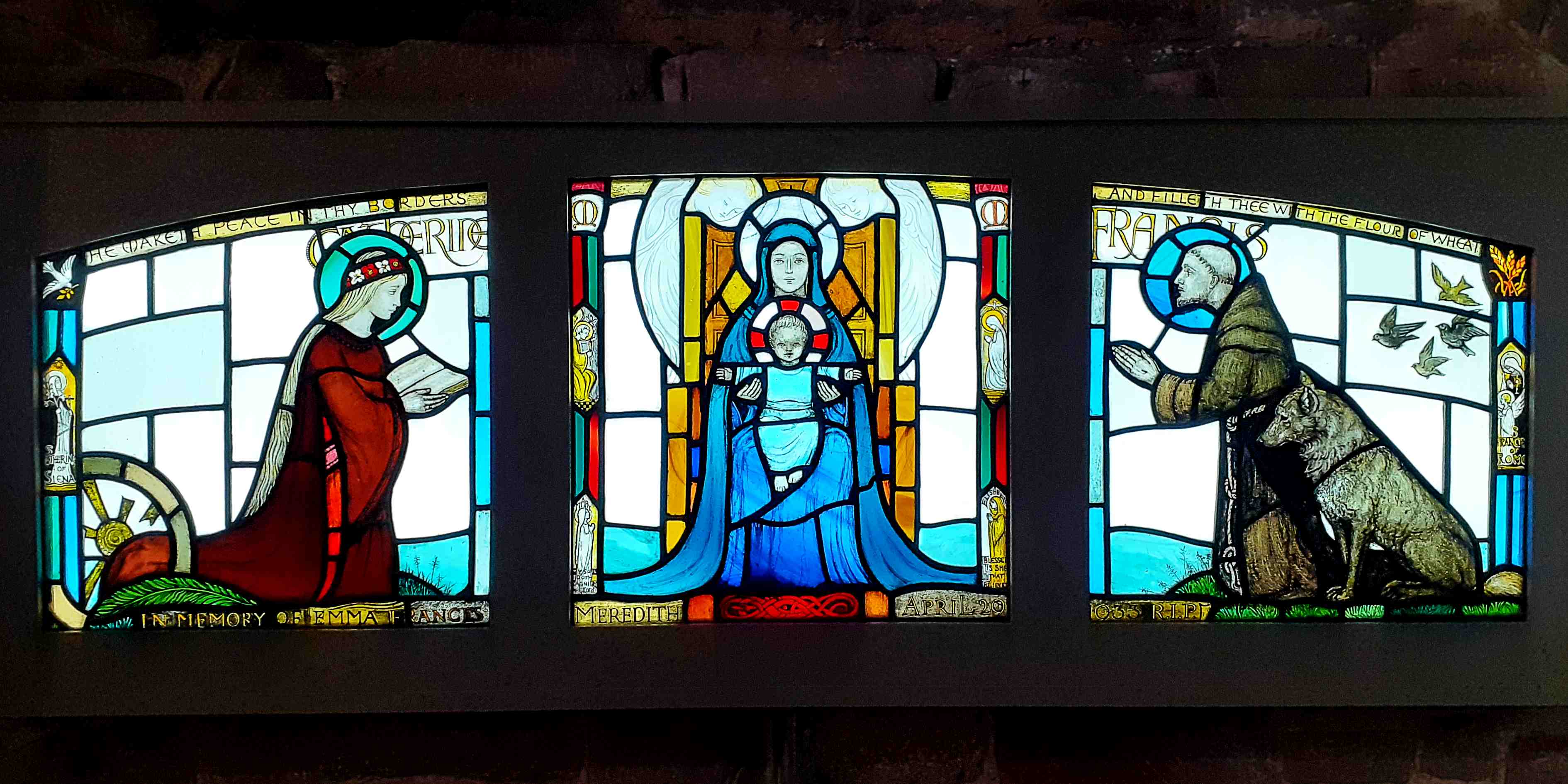
Theories – over who made it, where it came from, and what date it was made – have come and gone, none lasting long.
But one researcher is now sure she has the answers…
An accomplished piece
There is no doubt that it is an accomplished piece. Early theories, such as that it was a throw-away experimental piece, have been dismissed.
The image of the Madonna, which is in an icon style, is sensitively done and hypnotic in its gaze. The incidental details in the piece, of birds, calligraphy and patterns, show an artist confident in the skill of composition. The work is properly finished. It became rapidly clear that this is the work of a professional.
So… why was it abandoned and forgotten?

One theory was that it was a private commission, later donated to St Mary’s, who didn’t know quite what to do with it. The dedication in the glass, to Emma Frances Meredith, a Shrewsbury woman who died in the 1930s, might point in that direction. The image of St Francis, on the right side of the triptych, is probably a reference to the dedicatee’s middle name, as is the tiny figure of St Frances of Rome in the right-hand frame. (See pic right).
However, the work feels like more like a public profession of faith – and, anyway, one still needs an explanation for why St Catherine is there.
New theories emerge
The main, perhaps only, professional working in stained glass in Shrewsbury in the early twentieth century was Margaret Agnes Rope. Could she have been the artist? It was a theory that some people jumped at.
There are similarities. St Francis’s wolf is curiously similar to a dog that appears in many of Margaret’s windows, and the religious sensibility of the piece is very akin to Margaret’s. In the ‘mystery glass’, the text — ‘He maketh peace in thy borders and filleth thee with the flour of wheat’, from Psalm 147 — has strong connotations with Margaret Rope: Margaret also quoted psalms. The references to agriculture and birds are very like Marga’s.
But when Rope experts were consulted, they scotched the idea. They also dismissed another thought, that it could have been by Marga’s cousin, Margaret Aldrich Rope.
What’s more, Marga never really went in for this ‘icon-style’, which was taken up by some avant-garde stained-glass artists in the 1920s & 30s. She certainly flirted with it, but was never comfortable with it.
Whodunnit?
Enter now Catrin Meredith.
Catrin is a stained-glass researcher who has spent the last year looking for evidence of who the mystery artist might be – and she is now convinced she knows who it is. And her proofs seem pretty irrefutable.
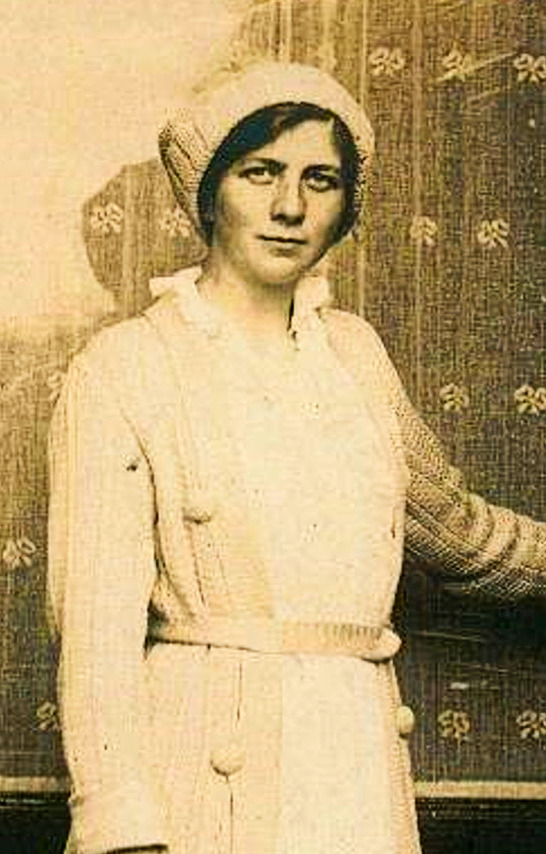
Following her researches, Catrin is sure that the panel is by Sister Joyce Mary, a professional stained-glass artist working in the inter-war years (who was simultaneously an Anglican ‘oblate’ nun). (By coincidence, Catrin shares her surname with Sister Joyce Mary, whose birth name was Joyce Meredith).
A brief, five-page account of Sister Joyce’s life had already been compiled by another researcher, Brother Jonathan, a monk at Mucknell Abbey. From this, Catrin discovered that Joyce Meredith, who was born in 1892, had possibly trained under the great Christopher Whall. Whall, a great exponent & theorist of the Later Arts & Crafts Movement practice of stained-glass, influenced many of the 1905-1940 generation of independent stained-glass makers.
Although little else is written about her, it is known that Joyce made a number of church windows, because she had listed them before she died.
Looking at the windows of Joyce’s that have been catalogued, one can describe her work as impressive and sure-footed, if not of the top rank.
She seemed to have two styles, an early one resembling works from the Powell studios and her later ‘icon-style’ pieces, which have a slight similarity to work by Trena Cox. Now and again, one spots influences that might have been come from the great Harry Clarke.
Shrewsbury mystery

But… did Sister Joyce make the mystery panel now in Shrewsbury?
According to the list of known Meredith pieces, Joyce had made another window in the area: in fact, her St Lucy at Withington (just twenty miles from Shrewsbury) is extraordinarily similar in style to the mystery-panel.
What’s more, Joyce had extended family in the district. Emma Meredith, to whom the mystery-panel is dedicated, was her cousin.
The mission-hall space
But Catrin then found an even more startling piece of evidence. It hadn’t been clear why the mystery-panel had St Catherine in it, but she thinks she now has a convincing answer.
The dedicatee, Emma, lived just around the corner from an outreach ‘mission’ hall set up by St Mary’s (the church where the panel was found) in the Coton Hill suburb of Shrewsbury. The name of it… St Catherine’s Hall.
Catrin is now sure that the mystery-panel was originally installed at St Catherine’s Hall in the 1930s. After that mission-hall was closed and converted into a Quaker Meeting House, the mystery-panel – somehow, eventually – made its way back to the mother church, St Mary’s.
There are still (as there always are!) many loose ends to tie up in this story; and Catrin and Brother Jonathan are still working on them. However, it’s hoped that Catrin will soon produce a lengthy monograph, which will flesh out a lot more of Joyce’s life-story, tell us more about Joyce’s works, and which will have many references.
Stained-glass enthusiasts will be impatient to see it!
Comparison
The reason that this article appears on a website dedicated to Margaret Agnes Rope is that, apart from clearing up the mistaken idea that Margaret made the panel, is to note the incredible similarities in the lives of Margaret and Joyce.
~ Both were independent single women making their way in a male world by sticking fiercely to their artistic calling. Both had art school training.
~ Both felt a religious conviction which guided their work. Margaret converted to Catholicism because of it, and it’s believed (though not yet proven absolutely) that Joyce did the same, toward the end of her life.
~ Marga became a Catholic Carmelite nun; Joyce also became a nun, in Anglican orders. Both continued to practise their stained-glass craft even after joining their respective orders.
~ Both followed the principles of the Later Arts & Crafts Movement.
~ Both used the workshops at Lowndes & Drury, the woman-friendly firm in London set up to help independent stained-glass artists.
~ Both seemed to have something in them of a free-spirit when they were younger.
~ Neither married, nor appear to have had significant love relationships before they became nuns.
~ They both had strong female influences. After her father died, Marga’s amazing aunts and sisters, all high-achievers, propelled Marga along. Likewise Joyce: after her parents died when she was a teenager, she was raised by her very accomplished unmarried aunts. It’s also clear that the last community that Joyce joined had strong links with female artists, among them the astonishing Beatrice Lithiby (stained glass designer, soldier and war artist).
~ They both had strong Shrewsbury/Shropshire connections.
~ They were close in age, with Marga being ten years older. It’s tempting to wonder if they met, though the timelines of the pair don’t seem to reveal many opportunities for such a meeting.
The Big Picture
Joyce’s story (and Marga’s for that matter) can tell us much about women’s independence and their artistic freedoms in the period 1900–1935. Although it was still a world clearly dominated by men, much is yet to be understood about how women in this period were growing in awareness of their own possibilities, and how they confirmed their own value in that ostensibly male world.
Catrin says she will also be looking at some of these deeper issues as she continues to research Joyce Meredith – making that another reason to be eager to see what she (eventually) publishes…
If you can add more thoughts or details concerning the life & works of Joyce Meredith, Catrin would love to hear from you. Click here to email Catrin
~
# If you’d like to comment on this article, please use the Comments Box below
# If you’d like an email alert to tell you when a new article is published on this website (about once a month), please click the ‘Follow’ button in the top right-hand column on this page.
 Celebrating Margaret Rope - stained glass-artist