Visitors to Shrewsbury General Hospital will be familiar with the triptych (see pic below), which can be seen by the entrance to its Children’s Unit.
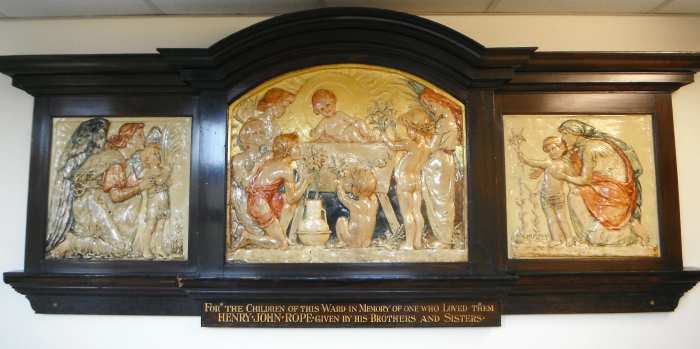
Created shortly after 1899 by Ellen Mary Rope, Marga’s aunt, it was dedicated to the memory of Marga’s father (Ellen’s brother) as a tribute to Dr Rope’s work, especiall in pediatrics.
It’s a much-loved piece, which partly explains why, even after so many changes in the NHS, it’s still on public show and not stored away in some dusty cellar.
(see the full story of the triptych by clicking here)
EMR
But who was Ellen Mary Rope?
(This is in fact an odd question. She was far more famous than Margaret during their era, the early half of the twentieth century, and has had much more written about her in art-history. Her work is on show in museums across England. Yet, she is largely out of fashion now).
Ellen Mary was Marga’s aunt on her father’s side. Margaret’s father’s family can probably be described as Bohemian, counting painters and sculptors among their number, and Ellen Mary was not the least of them.
Margaret would have met up with this artistic bunch in the summer months during holidays, as they lived the other side of the country, in East Anglia.
When Marga was just in her teens, Ellen Mary was already successful in business, having risen to the heights of being employed as a chief designer by the Della Robbia firm. She was also making works which got regularly reviewed in the art-journals of the time.
(In one of those curious coincidences which just seem to happen, Ellen had to make frequent visits to Marga’s part of the country – because Della Robbia’s main office was in Birkenhead, just fifty miles from Shrewsbury).
Like Marga later, Ellen Mary exhibited at the Arts & Crafts Exhibitions, though between 1899-1906.
And, like Marga, EMR had plumped for a profession in which she could work largely alone.
Thus, the two of them had huge amounts in common; and it is known that they both lived/worked in London in studios in close proximity to each other.
What is tantalising and frustrating is that we simply don’t know (yet) how close their working or intellectual relationship was.
Ellen Mary died in 1934, aged 79 – ten years after Marga had retired into a convent.
‘New Woman’?
Ellen Mary was no wilting flower: she is known to have travelled abroad, and exhibited at the Paris Salon in 1898.
And it was in this very decade of EMR’s international successes, the 1890s, that the idea of the ‘New Woman’ arises: an idea which stressed that women should no longer be seen as the inferior sex.
How much of a ‘New Woman’ was EMR?
Some isolated pieces of the historical jigsaw indicate what Ellen Mary’s social attitudes might have been.
Most significant is that EMR was invited to design spandrels for the Women’s Building at the Chicago 1893 World Columbian Exposition.

In 1894, she was commissioned by the social reformer (and proto-feminist) Octavia Hill to produce work for the Women’s University Settlement in London.
So – can one presume that EMR was on the side of women’s emancipation; and that her attitudes may have influenced the young Marga, who went on to be something of a rebel herself?
Well, it’s a huge leap of inference, but it seems to make sense.
Such a back-story would possibly account for why Marga, the home-educated daughter of a provincial doctor, destined for little more than marriage, became, out of the blue, a significant and original artist.
She owed some of it, surely, to her aunt.
Well…. in the absence of another explanation, it’s as good a theory for now as any!
If you would like to comment on this article, please use the Comments box further down this page
= = = = =
Acknowledgements
The best online article about EMR is to be found on Arthur Rope’s website – click here
A rundown of her works can be found on Sculpture Mapping
For further reading – Ellen Mary Rope; The Poet Sculptor by Benedict Read
 Celebrating Margaret Rope - stained glass-artist