Once the decision had been taken to remove a bad repair to a damaged face within a Margaret Rope stained glass window at Newport Catholic Church (see full story – The Newport Project), there was an immediate issue for those involved: what was the new replacement image to look like, especially if it were to be faithful to the original? It’s a perennial problem for restorers.
The task was to replace an unsatisfactory repair, carried out a decade ago, to the damaged face in the Our Lady window in the church and re-create an approximation to the original. (The Our Lady window is one of a series of five which Margaret Rope designed and made for Newport Church in the 1910s).
However, at this point, the restorers had no idea what the original, 1912 face looked like; surprisingly, no detailed photographs seem ever to have been taken of the window down the years.

Discovery
However, an answer came after a meticulous search was carried out at the recently-established Margaret Rope Archive. (Since the release of Margaret Rope’s papers from a vault in Birmingham to the archive ten years ago, many interesting finds have emerged among them).
The search revealed the existence of a postcard-copy of a studio photograph of the Our Lady window (see picture right). Not only that, but a member of the archive team, Roger Hall, identified some of Marga’s preliminary drawings for Our Lady’s face & head-covering.
Unfortunately, the actual original studio photograph cannot be found – it only survives as this postcard (presumably made for Margaret to send to family & friends).
What’s more, the lack of resolution in this postcard proved a problem, and the original drawings, though a great find, were really only sketches – so a new, different approach had to be taken up.
Image… flipped
It so happened that Margaret Rope had made another window featuring Our Lady at almost exactly the same time, namely The Nativity with Saints and Evangelists at Blaxhall Church in Suffolk. The Margaret Rope Archive team believe that the faces of Our Lady at both Newport and Blaxhall arose from the same studio drawing, one being flipped horizontally to the other.
Fortunately, high definition images are available for both the Blaxhall window and the sketch in the Archive, so it was decided to use these as the basis for the new design.
Using photoshop, a digital reconstruction, which put the Blaxhall face into the Newport ‘hole’, was made – and confirmed as the best solution.
Pre-eminent restorers
To avoid a repetition of earlier errors at Newport, it was necessary to identify the best artists for the task. Arthur Rope, the project leader, consulted Peter Cormack, the uncontested expert in Arts & Crafts Stained Glass, and the decision was to ask Holy Well Glass of Somerset to undertake the work.
Holy Well’s director, Stephen Clare, was recently awarded an MBE for his work in stained glass conservation. He is also a stained glass conservator by Royal Appointment to The Queen and national adviser on stained glass to the National Trust.
Holy Well agreed to help.
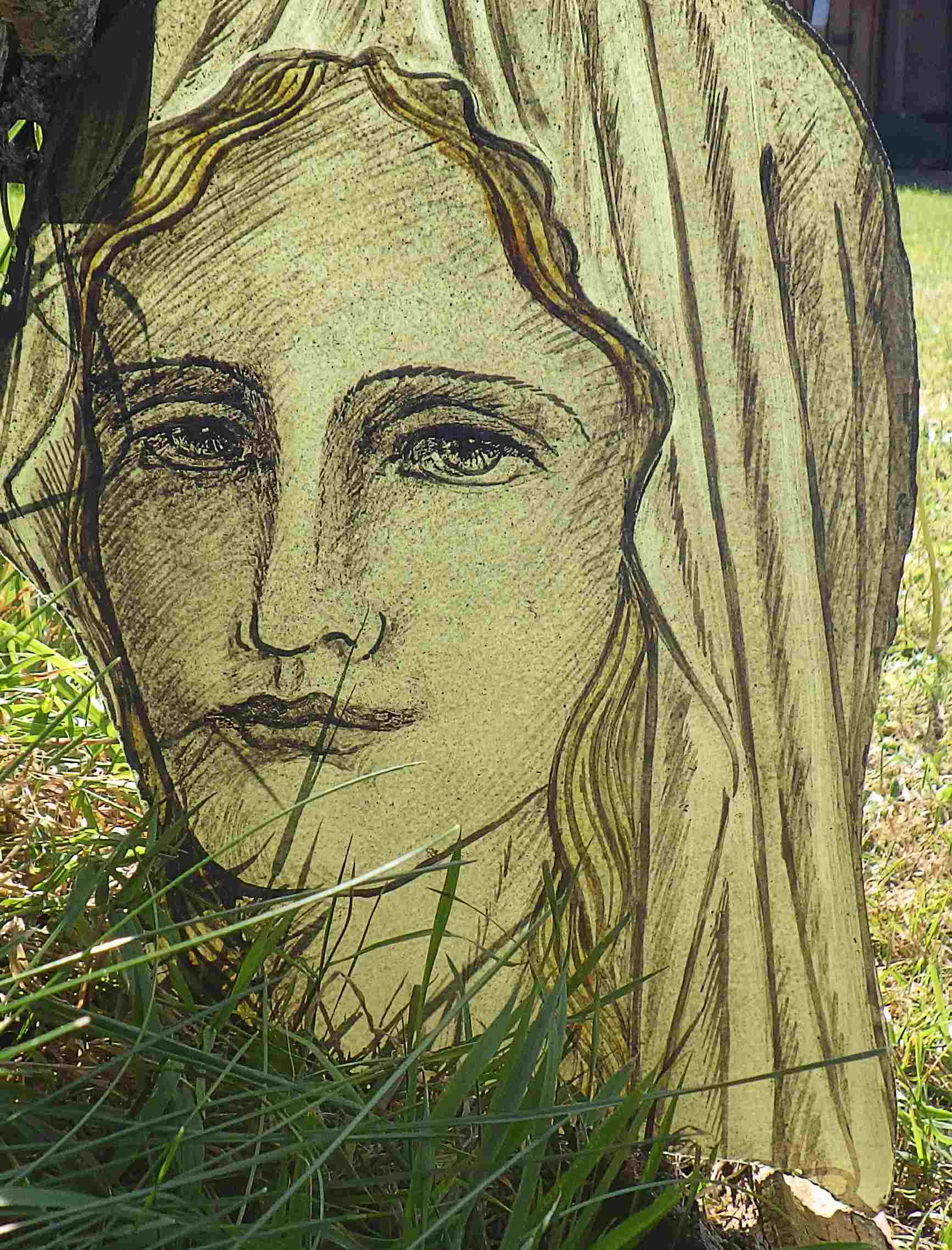
The firm’s Jack Clare visited the site to study the whole window and the types of glass used; he also extracted the ‘unsatisfactory’ face (see pic right), and took it take back to the studio in Wells to use as a shape.
Design process
A long process was underway.
Many more design adjustments were necessary (in addition to flipping the image), because the Infant Christ is on the lap in the Blaxhall window, but on the shoulder in the case of Newport.
Several drawings passed between Holy Well’s artist and the Archive team, and comments were fed back, perhaps three times.
Another challenge was to assess the level of shading on the new face, so that it should match the face of the Infant in brightness. At first, some were worried that the restored face was too dull in tone, but when the piece was viewed from the same distance as the window it became clear that this was not so.
There were other considerations. One of the issues that makes stained-glass conservation so challenging is that we don’t have the same materials today that our ancestors had. Marga had used a very thick, unforgiving type of glass (often called pot glass) which produces a jewelled effect though in a slightly random way. Modern glass is quite different! Holy Well had to deal with that issue as well.
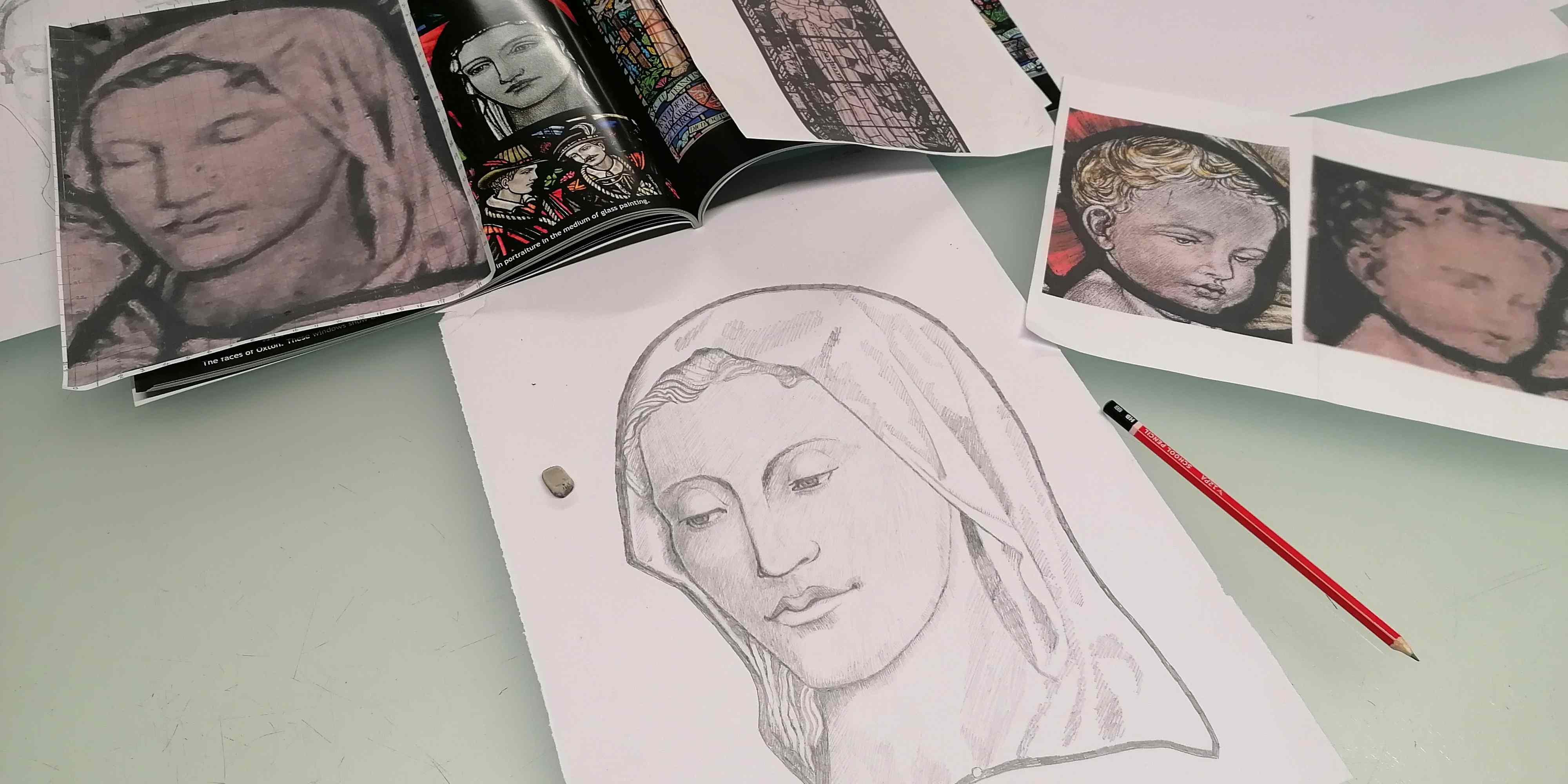
All in all the process took some six months and only then was the conservation work completed.
Next comes the installation & the public judgement…
(Many thanks to Arthur Rope for much of the information in this article)
The account of the restoration of the glass at Newport in 2022 has been split into three parts: Newport 1 (Setting Up the Project); Newport 2 (Restoring The Glass); Newport 3 (The Installation)
+
If you’d like to comment on this article, please use the Comments Box below
 Celebrating Margaret Rope - stained glass-artist