Imagine, if you would, an abandoned, decaying, but still magnificent palace, within which there is a precious artwork. It is impossible to get to the artwork as the palace is surrounded by high walls and a dense forest. The artwork itself is known to be gorgeous and a masterpiece, but has been seen by very few and never properly photographed – so it is a ‘known unknown’, a mystery within an enigma.
This is the situation of Margaret Rope’s wonderful Great West Window in the chapel of the Upholland College Estate (in Lancashire in the north of England).
Stately pile
The Upholland College complex itself is a sprawling neo-Gothic pile of a place (see pic below), every inch a kind of late nineteenth-century Hogwarts, complete with statues standing on its parapets. Built as an extravagant & expensive monument to the Roman Catholic confidence of the time, designed in fact to compete with Oxford colleges, for a century it served as the St Joseph’s College for Catholic young men, teaching them to go out and spread their faith.
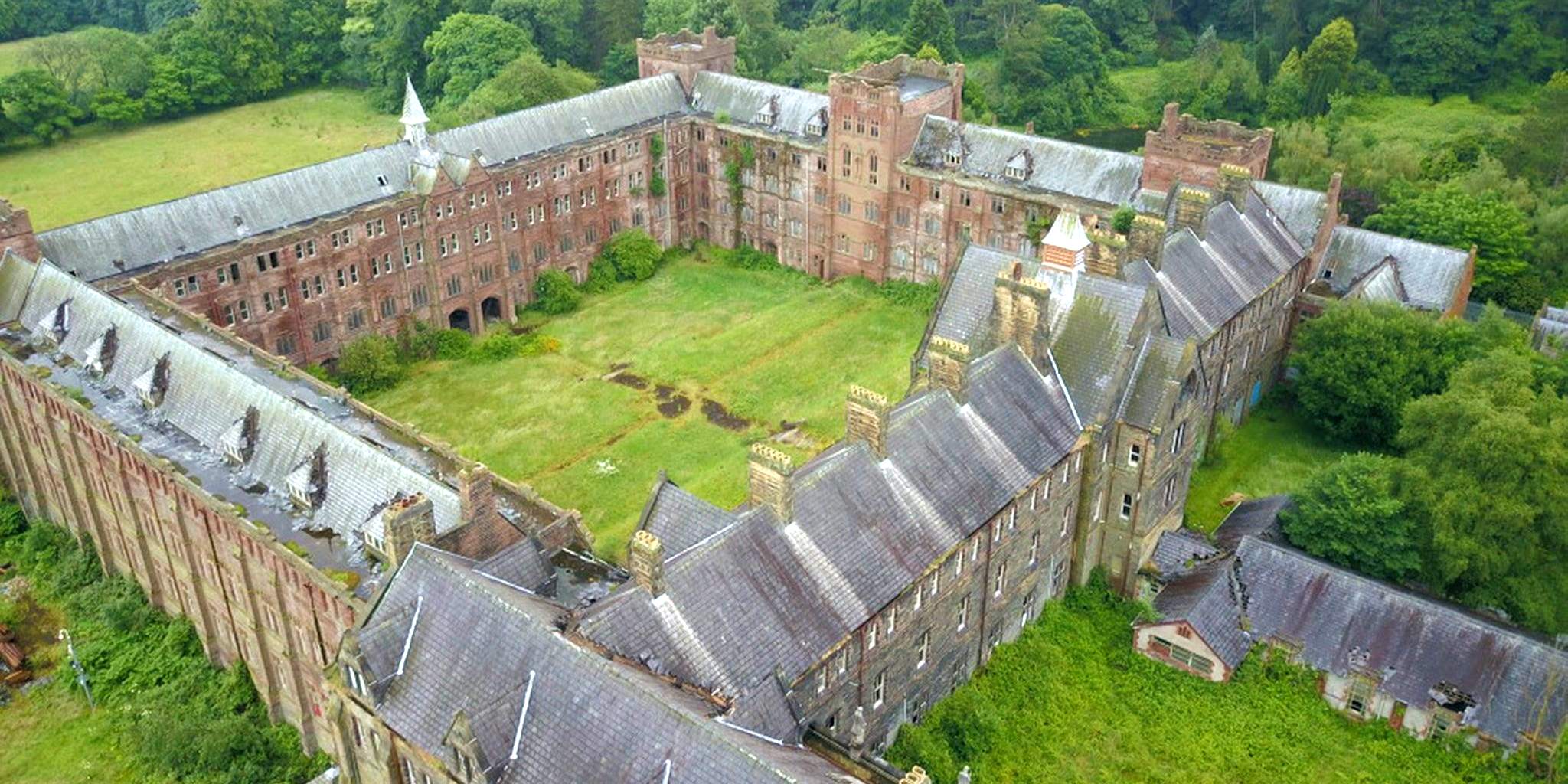
However, by the 1990s it no longer fitted the times, and, after a chequered period in its history, it closed. It is now in the hands of developers and, partly because of its listed status , subject to unresolved, massive wrangles between the developers and the planning authority.
Thus, for more than thirty years, the whole 400-acre estate, including the chapel, has fallen into dereliction, and only security guards now walk its grounds. In fact, the owners say they now cannot even permit art experts on to the site to see & record Marga’s stained glass, as the chapel is now too dangerous to enter.

Chasing the details
Although the only photos of Marga’s west window that exist are too blurry to work out any details, past historians and experts have written descriptions, which is how we know just what a huge achievement the window was.
We have also recently been aided by the fortuitous discovery of some of Margaret’s preliminary drawings (‘cartoons’) completed in black & white, and some colour vidimuses (vidimuses are small-scale drawings of the design, created early in the making process) in the Rope Archive. These (see Upholland vidimus, picture right) do give some idea of the intentions of the work, though they are small and are no substitute for the real thing.
It may not be possible to save the window now, but historians, heritage groups and art experts are working together to try and persuade the owners to at least allow photography of the window – thus to have some sort of proper record of it, before it is gone forever.
Competition
The story of how the window came to be is a fascinating one.
The college wished to commemorate its fifty-year anniversary in 1933 by commissioning some stained-glass for the ‘difficult’ west end of the chapel.
The west end was ‘difficult’ because, though the stonework at the west end, with all its tracery and so on, had been built ready for glass, the overall shapes of it were thought to be odd, and to lack the pattern needed for inspiring stained-glass: the stonework for the window is in a half-oval shape, and has over thirty spaces, small and large, that need to be filled.
A competition was organised and a number of designs rejected, before the authorities decided on a design from “a humble Carmelite nun” living in an enclosed convent on the other side of the country. The price was agreed at £450.
The irony is that Marga (by now ten years a nun, and known as Sister Margaret Of The Mother of God) would never have seen the site, nor indeed the finished work; her vows meant that she could not leave the convent.

This was a fruitful time for Margaret, who was enjoying renewed creative bursts and producing some of her most beautiful windows. Although she had been busy with parish-church windows, it must also have been exciting to work again on a large project.
Complexity
One reason that art-historians want detailed photos of this work is that it is hugely complex, and full of symbology. In his thesis about the institution, Michael Peyton quotes Canon Hanrahan’s description of it, written in the 1970s, when he calls it a ‘meditation on sacramental theology’.
The canon gives a long account of the window, as he has to, because there are very many scenes and figures within it, including the biblical figures of Melchizedek and Moses. These Old Testament figures (above the median line) are mirrored by New Testament and modern figures below.
But even the canon struggles to describe all the elements and to explain their significance. Suffice to say, that the right half of the window is apparently an illustration in colour & picture of the doctrine of the Roman Catholic Church and its left half an illustration of the authority of the Church.

A brilliant sight
But, for Marga, a work of art had to appeal to both the intellect and the senses. Her best windows are meant to be beautiful jewels.
So, for many of us, the second power of the window (if we ever get to see it) will consist as much of the thrill of seeing the setting sun burst through as a kaleidoscope in the glass to light up the whole chapel with colour.
One day… perhaps.
+
If you’d like to comment on this article, please use the Comments Box below
Addendum: There is some debate about when the work was actually finished. On page 186 of the BSMGP Journal Vol XLI 2017 (in the ‘Glass House Records’ article), there are references to invoices for installation & fixing this window in late 1938. They may point to an instance of late payment, or may indicate how long the piece took to complete. (Thanks to AR for this information). The next step is to research minutes of the meetings of the college authorities.
 Celebrating Margaret Rope - stained glass-artist