As we all know, the bland words “attributed to…” should always be treated with caution. When seen on a label in a gallery, these words often actually mean “…there’s a story about this work, but we don’t know if we can believe it…”
The same problem applies, sadly, to a work “attributed to” Margaret Rope – the Shrewsbury Cathedral Reliquary.
In actual fact, although it has been labelled many times down the years as being by the hand of Margaret Rope, it’s not.
Silverware
The piece is a lovely item, and was probably commissioned in the years around 1910. It is made of silver with a coloured & engraved front and has a glass bulb in its centre, through which one can see the relic.
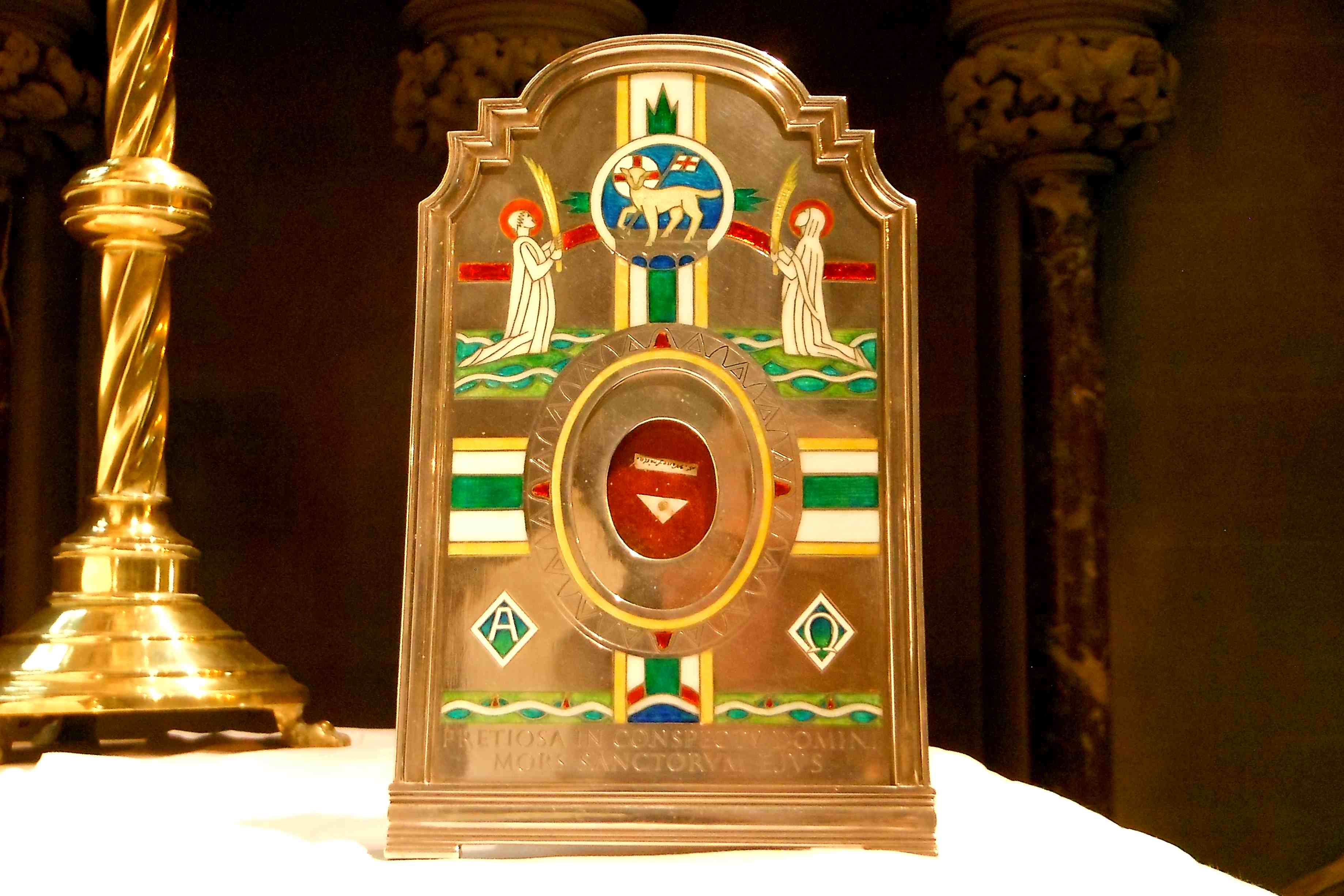
Why – specifically – it was made is not clear. Reliquaries are created to hold small relics of a saint or holy person – a lock of hair or a fragment of bone perhaps. But this one doesn’t seem to have been designed for any particular relic.
In fact, the design is a generic one for any martyr. The figures on either side of the Lamb (one male, one female) seem to correspond to St John’s description of his vision in the Book Of Revelation: martyrs robed in white, with palm branches in their hands, before the Lamb (Rev 7:9)*. The Latin inscription translates as ‘Precious in the sight of the Lord [is] the death of his saints’ (Psalm 115/116, v 15)*.
Artist in residence
It’s easy to see however why the story that Marga might have made it might have arisen – for a number of reasons:-
# Margaret was the ‘go-to’ artist at Shrewsbury Cathedral in this period, thanks to her mentor and patron Canon Moriarty. It’s not unreasonable to think Moriarty may, at the very least, have consulted her.
# The design on it is fresh and modern, not ‘traditional’, though it is recognisably Catholic. This aspect would point toward Marga as the possible maker.
# Although Marga became known for her stained-glass work, she had trained in a number of disciplines in her early years at art school, including metalwork. Whoever attributed the reliquary to Marga must have thought she had the skills to work in silver as well.

# And finally, reliquaries are created to hold relics of a saint or holy person; in this instance, this reliquary holds a small fragment of bone, reputedly from a finger of Saint Winefride, the patron saint of Shrewsbury Diocese. (The piece is even in the colours of Shrewsbury, with stripes of amber & blue). The connection is that Marga had a great affinity for Saint Winefride.
Stebbings
However, all that anyone has to do to truly identify the maker is to turn the reliquary upside down, and observe the mark! This proves that the reliquary is the work of silversmith Robert Stebbings, who seems to have been active from around 1882 to 1913.
However, poor Robert has rather disappeared into the mists of time, and very little is known about him. We would certainly love to know where his workshop was – does anybody know?
Design
However, let’s not suppress a good story too quickly.
Stebbings was not an artist as such, more a superbly skilled artisan. His cutlery is what is collected these days, and if he did produce ‘artworks’, not much is known of them now.
So… is the design on the front of the reliquary his? Or was he sent a design, which he then depicted? If so, who was the designer?
Research goes on…
++
* In strict fact, St John describes the martyrs as standing – and these two are kneeling.
* The Latin is: Pretiosa In Conspectu Domini / Mors Sanctorum Ejus
(NOTE: Many thanks for their help to Father Peter Phillips, of the Shrewsbury Diocese Archives, and to Roger Hall; they supplied a number of the facts. But the responsibility for the speculations cannot be theirs; it is mine alone…! MS)
+
If you’d like to comment on this article, please use the Comments Box below
To receive an email alert, about once a month, to tell you when a new article appears on this website, see the button marked ‘Get Alerts via Email‘ on the top right side of this page, then put your email address in the empty box; then click ‘Follow‘.
 Celebrating Margaret Rope - stained glass-artist
Kelly’s Post Office directory 1891 has Robert Stebbings and Sons at 18 Myddleton St Clerkenwell in London, “maker of knives and forks”. This may have been his workshop as well as his home. He doesn’t seem to have worked for a larger operation, and passed on his silversmith business to his son.
He died in 1913.
JF
LikeLike