At last, a great treasure, which has been hidden and languishing for decades in a derelict church in the north-west of England, is a secret no more.
For the first time, we know full details of the ‘Upholland Great West Window’ (1938), one of Margaret Rope’s last great works.
Historians have been aware of how impressive and significant this window must be because of comments in pre-war documents and historic eye-witness descriptions. However, strangely, little visual evidence of its appearance exists; no useful published photos survive. It is also in a building that has been closed to the public for decades.

Thus we have a masterpiece that has been hidden for years – as no one is permitted to go inside the derelict building – and it would seem an impossible task to find out much more about it.
But now, thanks to a good deal of detective work, we at least have an accurate idea of what it must look like, and an explanation of the complexities of its design.
Upholland
In a previous post on this website, we profiled the Upholland story (including the strange route by which Marga came to be selected as the artist to make this large west window).
Upholland College (see pic below) is a grand Victorian pile, complete with large chapel, extensive grounds, and even a lake, all in deep countryside. Almost forty years ago it was abandoned, and high security fences put up around it. No member of the public has been allowed in since.
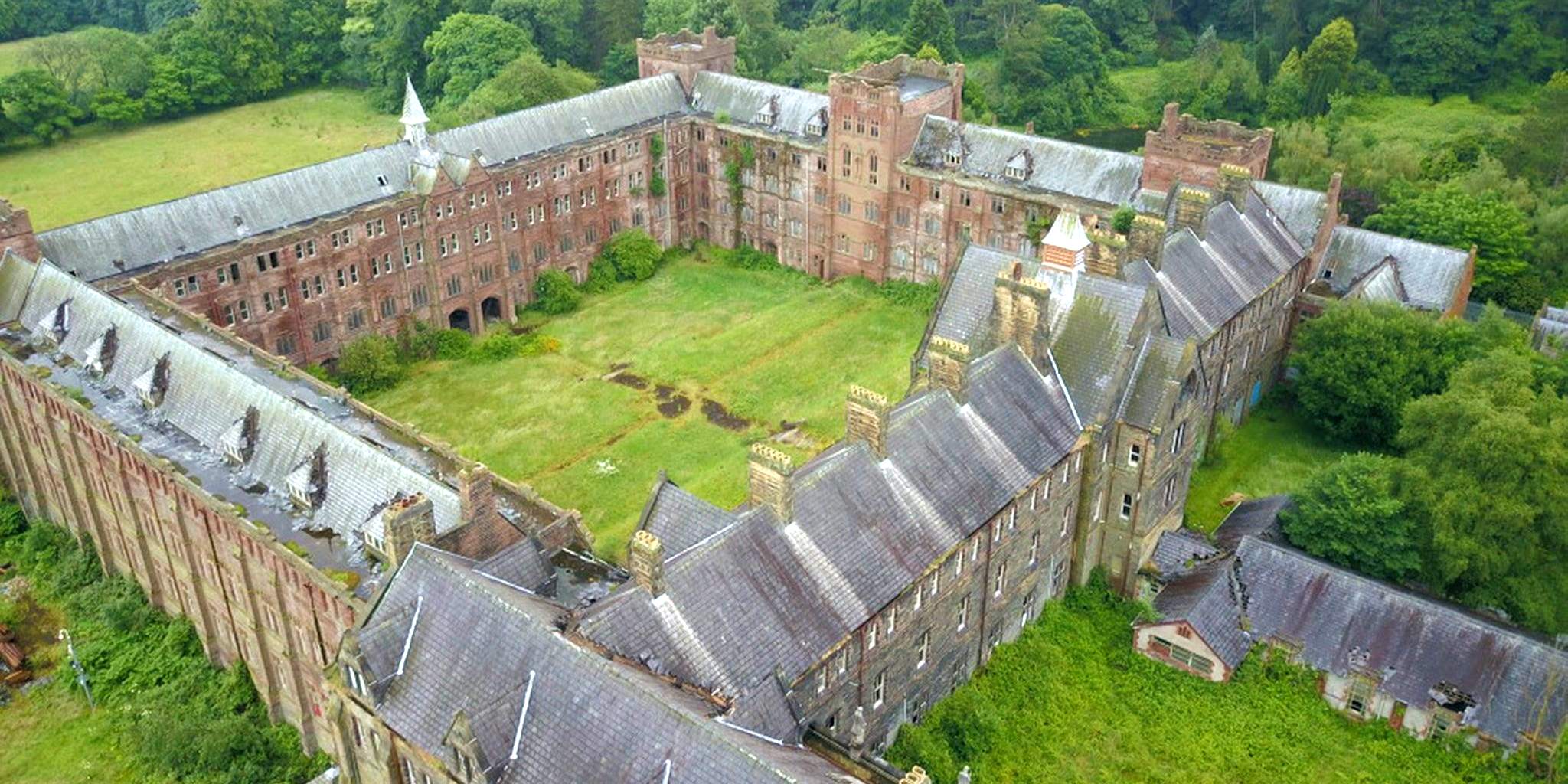
The great shame of this is that Margaret Rope’s Great West Window languishes in the old chapel. We can also be sure that it is in a state of dangerous neglect.
Reconstruction
So the small group of volunteers at the Margaret Rope Archives in Suffolk set to work. Using Marga’s preliminary cartoons, old design papers, fuzzy pictures of the work, and one enthusiast’s excellent depiction, they came up with a reconstruction: the first full image of the window.
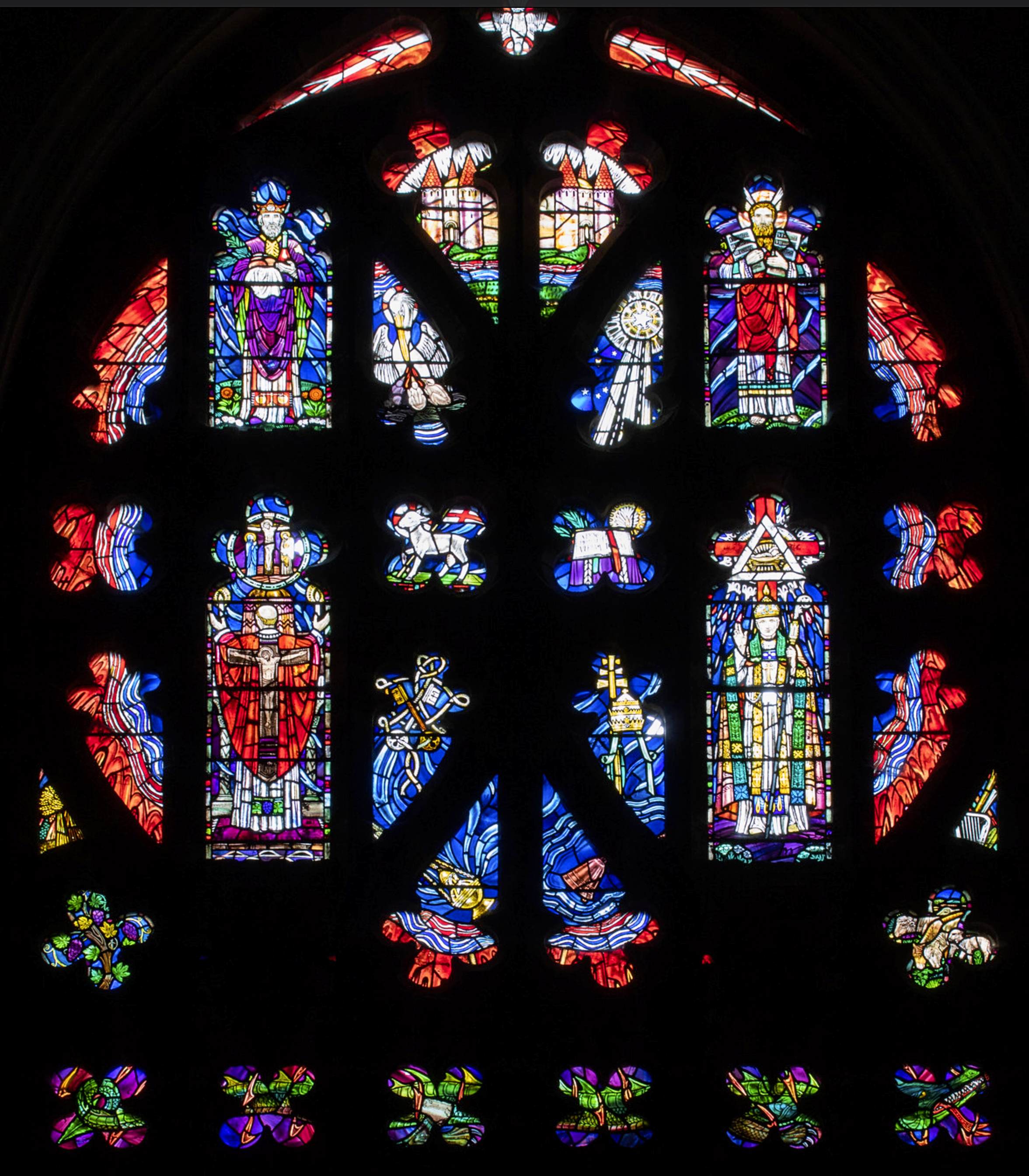
One can see straight-away that it is clearly a major work, combining both the magic aspects of glass & sunlight & colour & design alongside a hugely complex meaning.
Margaret Rope was 56 years old, in her mature phase as an artist, when she made this piece. We know that she had spent hours doing research into the forms and meanings of the rituals of the Catholic Church over the previous years. Her Catholicism was her driving force.
And her researches seem to have come to fruition in this window.
(While we cannot be sure, it’s more than likely that she composed this piece without much interference from the commissioning authority. It’s the way that she liked to work!)
Exegesis
The Margaret Rope scholar Roger Hall explains the window as a portrayal of the concept of priesthood.
This makes a deal of sense, as the origin-reason for Upholland itself was to be a northern college of learning for Catholic priests in England.
Roger has explained each and every nook & cranny of the window’s design in a lengthy monograph. Not only do his researches show that nothing in a Marga window is there for no reason, but that Marga deeply understood the concepts she was portraying.
In his monograph, Roger extensively references the Biblical and theological matters that she is quoting in her images.
Design
Roger shows that the window is split into four sections, represented by Melchizedek and the Modern Priest – who stand for Sacrifice – and Moses and The Bishop – who stand for Teaching & Guidance. The top half of the window is Old Testament, the bottom half New Testament.
Roger examines and outlines the dozens of tiny but significant details that come up in the windows, even in the tracery as well. Each detail can be seen an aspect of Priesthood, ancient and present-day.
To add some drama, running along the bottom of the window in a sinuous trail is a long green dragon/serpent, the Devil, reminding the priests in the chapel congregation below that they are particularly subject to his attentions…
Presence
It’s a peculiar fact that Marga’s spirit was probably the only female ‘presence’ in the all-male assembly that would have attended services in the chapel.
And Roger Hall thinks she reinforced her presence with a little trick within the design.

The keys of Heaven (spoken of by Jesus in Matthew 16:11-19) are traditionally depicted with a rope or cord binding or knotting them, but in this window, surprisingly, the cord is only loosely looped around the keys. This image is also so elaborate that Roger’s theory is that it is a play-on-words (a ‘rebus’) referencing Marga’s own surname – Rope.
It’s an attractive theory, and quite likely, as Marga had used the Rope rebus a couple of times in her career before.
Notwithstanding her obvious respect for her theme and her respect for the work , it’s fascinating to think that Marga was determined to leave a little of her own self in this huge and complex masterpiece.
+++
Refs:
To read Roger Hall’s interpretations of all the images in the window, please click here.
For the background to the story of the Upholland Great West Window, please click here.
A larger image of the window’s image reconstruction can be found by clicking here.
~
# If you’d like to comment on this article, please use the Comments Box below
# If you’d like an email alert to tell you when a new article is published on this website (about once a month), please click the ‘Follow’ button in the top right-hand column on this page.
 Celebrating Margaret Rope - stained glass-artist
Absolutely fascinating.
LikeLike