When Margaret Rope’s Great West Window was unveiled in Shrewsbury Cathedral in 1910, she was still young, just 28, but she had studied art-history deeply. Careful observers at the time will have noticed evidence of this in one of the window’s panels, The Death of St Winefride.
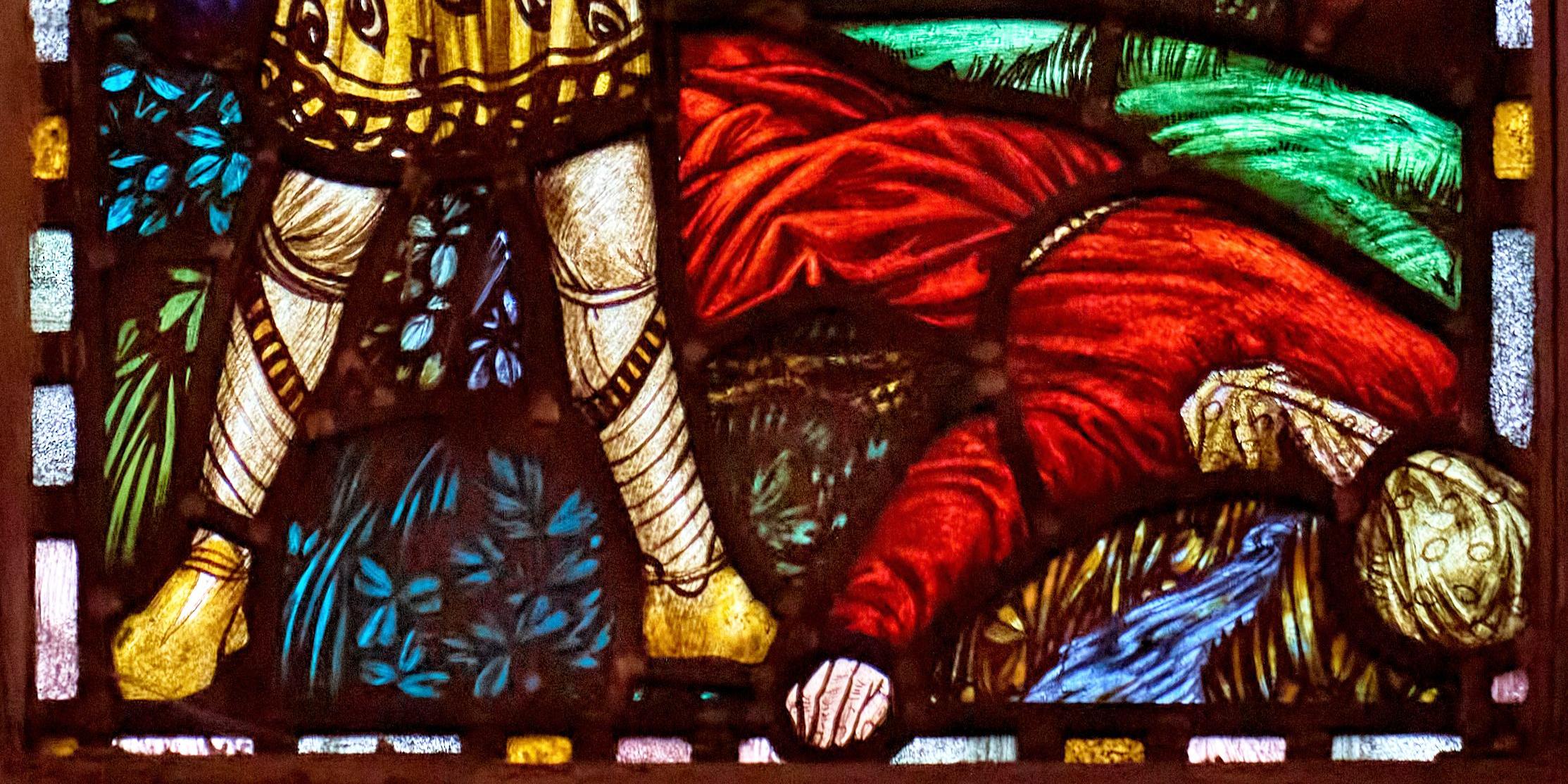
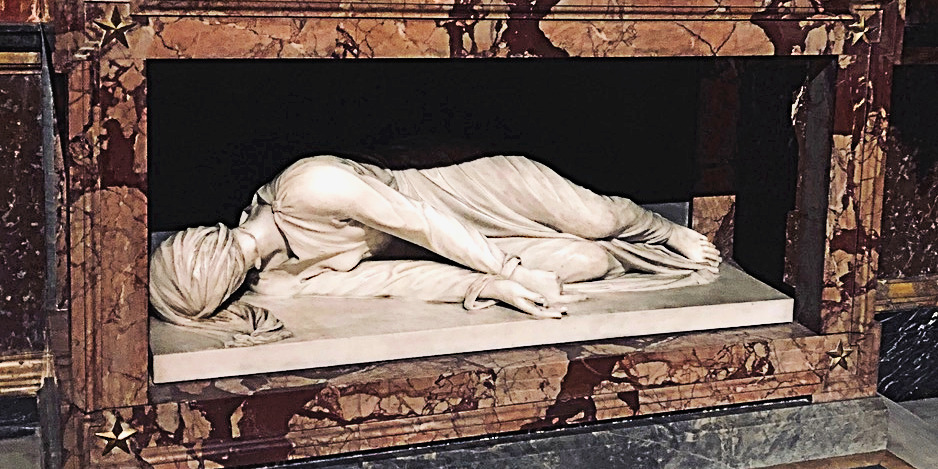
The scene (above) acknowledges in it the famous sculpture of St Cecilia In Death by Stefano Maderno made in 1600. The similarities in pose are striking, even down to the prone body, the outstretched arm, and the head, under a cloth and turned away from the viewer.
The question is: why?
Found in the archives
It is known that Margaret knew of the Saint Cecilia In Death sculpture, because she saved a postcard of it. Marga, as many artists do, collected old clippings, photographs from magazines, art-cards and so on, which she kept in cardboard boxes right through her life. Presumably they provided inspiration.
Fortunately, after her death, these boxes were saved and transferred to the Rope Archives; and nowadays these scraps give scholars an insight into how she thought. It was amongst these scraps that the postcard was found.
Thanks to this card, scholars at the Archive, particularly Roger Hall, started to see the connections between Marga’s own Death of St Winefride and the Maderno piece, and, with further research, the connection became more obvious.
Cecilia in England
Maderno’s Cecilia sculpture is life-size. The sculptor said that he was actually present when the tomb of St Cecilia was opened in 1599 in Rome, more than a millennium after her death. According to him, the body was as fresh as when alive: he said he simply sculpted exactly what he saw. The saint’s head (Cecilia was a martyr, who had been decapitated by her prosecutors) is within a shroud.
The statue is to be found in the Basilica of Santa Cecilia in Rome.
Did Marga get to see the sculpture?
Not in Rome, no. But, in fact, a surprisingly good copy of it existed in the Church of The Oratory in London. The Oratory had been built in 1884 and was Catholicism’s biggest church in England until Westminster Cathedral was erected in 1912.
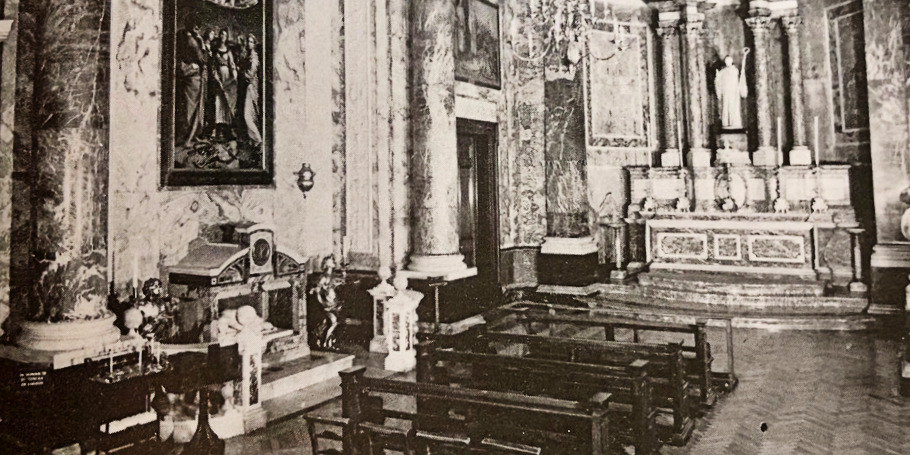
It’s more than possible that Marga saw the copy here, in person. In the first decade of the twentieth-century, Marga was visiting London to liaise with some stained-glass studios in Fulham. As a decided Catholic, she would surely have gone to The Oratory, the major church of English Catholicism, while she was there.
St Winefride
Marga’s Death of Saint Winefride panel was clearly important to her. (Elsewhere on this website, we have commented on some of the deeper meanings ascribed to this particular St Winefride scene). But why did Marga borrow Maderno’s ideas about a quite different saint for her version of St Winefride?
Some answers suggest themselves. The borrowing might well allude to certain parallels between Cecilia and Winefride…:
• Both were chased down by men who resented not just the women’s strong faith but also their commitment to their chastity*
• Both women were young (as was Marga when she made the Greet West Window)
• Both were decapitated by their pursuers
• Both had astonishing ‘preservation’ miracles around them: legend tells that St Winefride’s head was restored to her; and, as we’ve noted, St Cecilia’s body, when found in 1599, had apparently not decayed.
Martyrs
Catholics in England around the end of the nineteenth century laid great emphasis on their faith’s martyrs, ancient and new. Not only did it play into their sense of suffering, after centuries of harassment and prejudice in England, but also reflected the rather odd (well, odd to us nowadays anyway) faint air of sadomasochism in the general art of the time. Following that logic, it is no surprise that a copy of Maderno’s sculpture was one of the first statues specifically made for the Oratory Church.
It is interesting to note too that Marga (and Maderno, in this instance) are not as exploitative as other artists when it comes to depictions of martyrs. In the image of Winefride, Marga is at least trying to recognise a situation where a real woman has been attacked. And, in Marga’s same Great West Window, there is actually a second version of Winefride, showing the saint standing upright, fearless and strong.
And – Marga & Cecilia
As an afterword, it is worth remembering that Marga later depicted St Cecilia as well, in her 1912 Visitation Window, though Cecilia is in her other guise here, as a spirit-angel, the patron saint of music. See pic below.
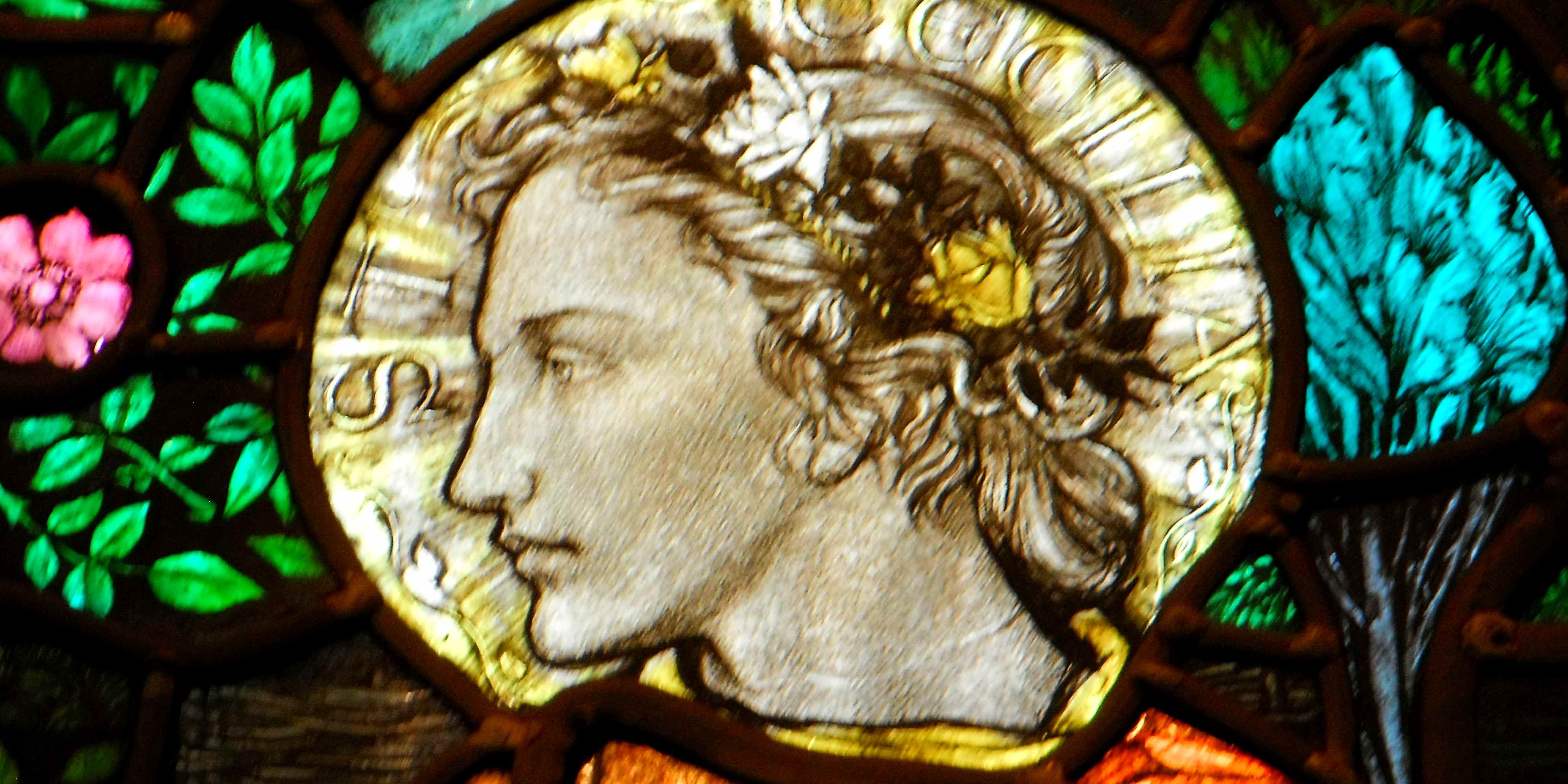
Marga’s Cecilia is, like many of Marga’s females, no simpering girl: but, fascinatingly, still bears the marks of her persecution – you can just about see that Marga has painted the scar around her neck, where her head would have been cut off.
There is still research to be done on this matter. There is even a feeling that Marga might have identified strongly with these two young, female martyr-saints, though, in what ways, we don’t yet know…
*according to the version of St Cecilia’s story as told by Chaucer
# If you’d like to comment on this article, please use the Comments Box below
# If you’d like an email alert to tell you when a new article is published on this website (about once a month), please click the ‘Follow’ button in the top right-hand column on this page.

