It’s difficult to think of a period of English history that obsesses people more than that of the Tudors; and the two giants of that time are, arguably, King Henry VIII and his advisor Thomas More.
Judging by one of her paintings, it seems Margaret Rope agreed with that assessment.
King Henry and More, who were friends to start with, were similar in many ways – both were scholars, fascinated by religion, easy in power, single-minded.
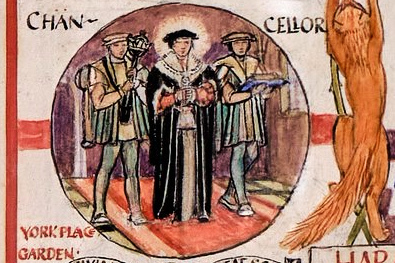
Henry promoted More from ordinary courtier to Chancellor (the highest office in the land after the king) – only for them in later years to argue bitterly about religion. That did not work out well – the upshot was that Henry saw to it that More was executed for his beliefs.
On his death Thomas More was immediately viewed across Europe as a martyr for his Catholic faith.
Pictorial biography
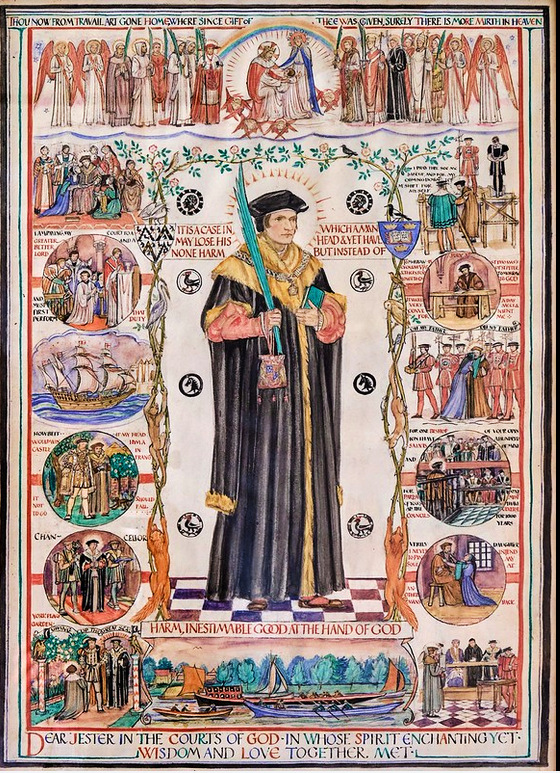
The whole story of this relationship between Henry and Thomas, from start to end, is told by Margaret Rope in a painting now in The Holy Family Church in Suffolk. In it, Margaret has outlined twelve stages of the relationship between Henry and Thomas – from friendship to opposition, and thence to More’s death.
And, in a recent, brilliant monograph, the scholar Roger Hall has explained many of the hidden references in the painting.
Work with purpose
For all that it is packed with detail, this picture, painted in ink & watercolour in the 1920s, is a relatively small work, almost a miniaturist piece. It is barely two feet high.
In fact, it’s hard to understand which she created it. She was a glass-artist first & foremost, and similar ink/watercolour paintings by her are uncomplicated affairs, more in the nature of ephemera – yet this one must have taken hours of research and, as such, was clearly important to her. Each tiny detail means something, even down to the animals in the frame (see the image of the lion in the section below).
The painting would however, for all its miniature presentation, have had profound resonance for viewers when it was created.
Roman Catholics in England during Margaret’s lifetime were rather obsessed with the subject of their sixteenth-century English martyrs. Top of their list of the martyrs who had died for the ‘Old Faith’ was Thomas More; and during the time that Margaret was painting this picture, there was fierce lobbying from England to persuade the Pope to finally make a saint of him. (More was finally declared a saint in 1935, a decade after this painting was created).
So – is Marga’s painting simply an addition to that propaganda campaign? Actually, that would be too easy an interpretation, and the answer is no.
(It is not clear however whether it was even shown in a full-blown public exhibition… was it instead intended as a significant gift to someone perhaps? … more research is required).
Biographical
To understand the painting, it is best to read Roger Hall’s profile of it (which can be found online on the official Margaret Rope website). In Mr Hall’s exposition, which is a full ten pages long, Mr Hall painstakingly goes through each of the dozen scenes in the painting, explaining the very many references within them.
It turns out that, in essence, Marga has painted a biography of the relationship between Henry and Thomas, even showing some sympathy for Henry (the supposed villain of the story!) in the early vignettes; it is far from a propaganda piece.
(This interpretation of the painting perhaps explains why there is not more emphasis on More’s philosophical writings).
Mr Hall goes deep into the various symbols and implications present in each vignette. One of the most curious examples of his research is the way in which he identifies an appearance by two otherwise mysterious Roman soldiers – as members of the so-called ‘Theban Legion’. Similarly, he goes into full detail about why there is a flag showing crescent moons in one of the sections. Without Mr Hall’s research, it is likely these references, as well as quite a few others in the painting, would remain obscure. Margaret clearly enjoyed leaving puzzles within her works.
Scholar
It’s very likely that Margaret saw herself as a scholar (see Marga And Scholasticism) so her references are usually meticulous and accurate.
However, infrequent as it was, she could slip up.
Roger Hall, with the severity of a true researcher, points out a couple of her mistakes. In one example, he notices that when Marga quotes a poem of one of her contemporaries, she gets the quote slightly wrong. It’s good to know that Mr Hall goes that extra mile!
For anyone interested in the life of Thomas More – Tudor figure as well as Catholic martyr -, a quiet afternoon studying Marga’s painting whilst simultaneously reading Mr Hall’s thesis would be an afternoon well-spent.
Addendum
It is worth pointing out that Marga did depict Thomas More in her stained-glass too. She pictured him in Shrewsbury Cathedral’s Great West Window, in Latchford RC Church, and in a Kesgrave Holy Family Church window.
# If you’d like to comment on this article, please use the Comments Box below
# If you’d like an email alert to tell you when a new article is published on this website (about once a month), please click the ‘Follow’ button in the top right-hand column on this page.

